Simplify Business Growth with Smart CRM Tools
 Veer
Veer

 Veer
Veer
Explore how CRM tools can transform your business operations, from managing leads to closing sales—featuring real-world insights and smart examples inspired by Capsule’s simplicity and efficiency.
Unless you have ever been caught scrambling to maintain dozens of email conversations, sticky notes, and spreadsheets in order to keep up with clients, you are not alone. This is when relationship management becomes a full-time occupation, especially in the case of most businesses, particularly small ones. That is where the CRM tools sneak in and rescue the situation.
Imagine that a CRM device (Customer Relationship Management system) is your virtual assistant, who will never forget a name, meeting, or follow-up. It does not merely put things in a place, but it links the dots between your customers, your team, and your goals.
If that is too technical, now, imagine this: every time a customer sends you a message, orders something or even clicks your CRM notes it down. Then, later, when you wish to get in touch, with a personal touch, or know what is working, all is there, in order, ready, waiting.
The secret here is that business is all about relationships. However, as the size of your business increases, it becomes difficult to remember the names of people. It is why sales CRM tools are sworn by entrepreneurs and sales teams.
A CRM can replace the use of memory or disorganized email communications and serves as a single point where you are able to monitor conversations, deals, and customer preferences. You could be dealing with a small company or you could be dealing with an office of sales; a CRM makes sure that you do not lose focus of what is really important to you- your customers.
And, yes, there are some free CRM tools on the market that will provide you with a good kick-off before you spend a single penny. Services such as Capsule, to name an example, are simple and powerful enough so as to allow small teams to get organized without feeling overwhelmed. 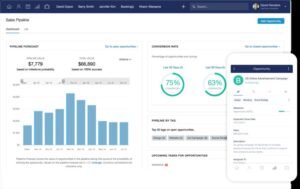
One thing needs to be made clear: CRM tools are not merely tools of putting contacts into the bank, but tools of action. Here’s what they can do for you: Centralized Information No more scattered data. All customer information, emails, calls, and notes are all in a single clean dashboard.
Task Automation Fantastic CRM applications that work with small businesses allow you to automate time-consuming activities such as follow-ups, reminders, and updates of deals, thereby spending time on what is important to you: expanding your business.
Pipeline Management Regardless of the number of deals you need to follow, five or fifty, sales CRM tools display the position of each lead in the path between interested and closed.
Data-Driven Insights The most ideal CRM tools give you reports on what is working and what is not and assist you in making smarter decisions in a shorter time.
It is not only that but also about efficiency. You get to view the greater picture and at the same time handle the finer details that make the customers make a revisit.
ALSO READ: Mastering Workflows with the Best CRM Tools—ClickUp
The number of CRM tools examples is dozens, and each of them is charming. Others are created to serve big companies with complicated requirements, whereas others, such as Capsule, are about maintaining things as simple as possible to small and medium businesses. 
In short, this is what the various CRMs excel in:
HubSpot CRM: HubSpot is famous for its powerful free version and marketing features.
Zoho CRM: Ideal when flexibility and automation are required by the team.
Capsule CRM: Capsule is simple enough to use yet good enough to perform.
Salesforce: The business leader that comes with a high cost of customization (and cost).
These instances demonstrate that, be it a startup or even scaling up, there is a CRM tool in the market that will match your specific journey.
To small business owners, every lead counts, and every relationship matters. That is why finding reliable CRM tools for a small business can be game-changing. Imagine running a local design agency: you have clients, projects, and deadlines everywhere. A CRM helps you remember who needs a quote, which client is due for a check-in, and even reminds you to follow up after delivering a project. That is not just organization; it’s building relationships. That kind of attention over time converts one-time customers into loyal partners. And the best part? You don’t need to spend thousands to get started. Many free CRM tools offer just enough to help you stay organized and grow—without draining your budget.
Before you get started, ask yourself: Is your need for a CRM primarily for sales tracking or also for marketing purposes? How many people will use it daily? Do I want something simple or fully customizable? If your answers tend to go in the direction of “simple, effective,” then tools like Capsule hit the sweet spot: they’re tailored to small teams looking for clarity and control with no extra complexity. But for a larger business that requires deep automation, reporting, and integrations, you might consider enterprise-grade sales CRM tools that scale with you as you grow. Either way, the objective remains the same—to make it easier to connect, sell, and succeed.
At the core of each and every successful business is a system that understands people. That is exactly what CRM tools do: they help you organize, engage in, and grow relationships with ease. Whether you are testing free CRM tools or investing in the best CRM tools available, remember that the right CRM doesn’t just fit your workflow—it enhances it. And if you’re looking for inspiration, look toward platforms like Capsule, where simplicity meets smart functionality. Sometimes, it’s not about having more features but about making sure you have the right ones that make every customer feel important.

© 2026. All rights reserved by Saasutility.




No Comments